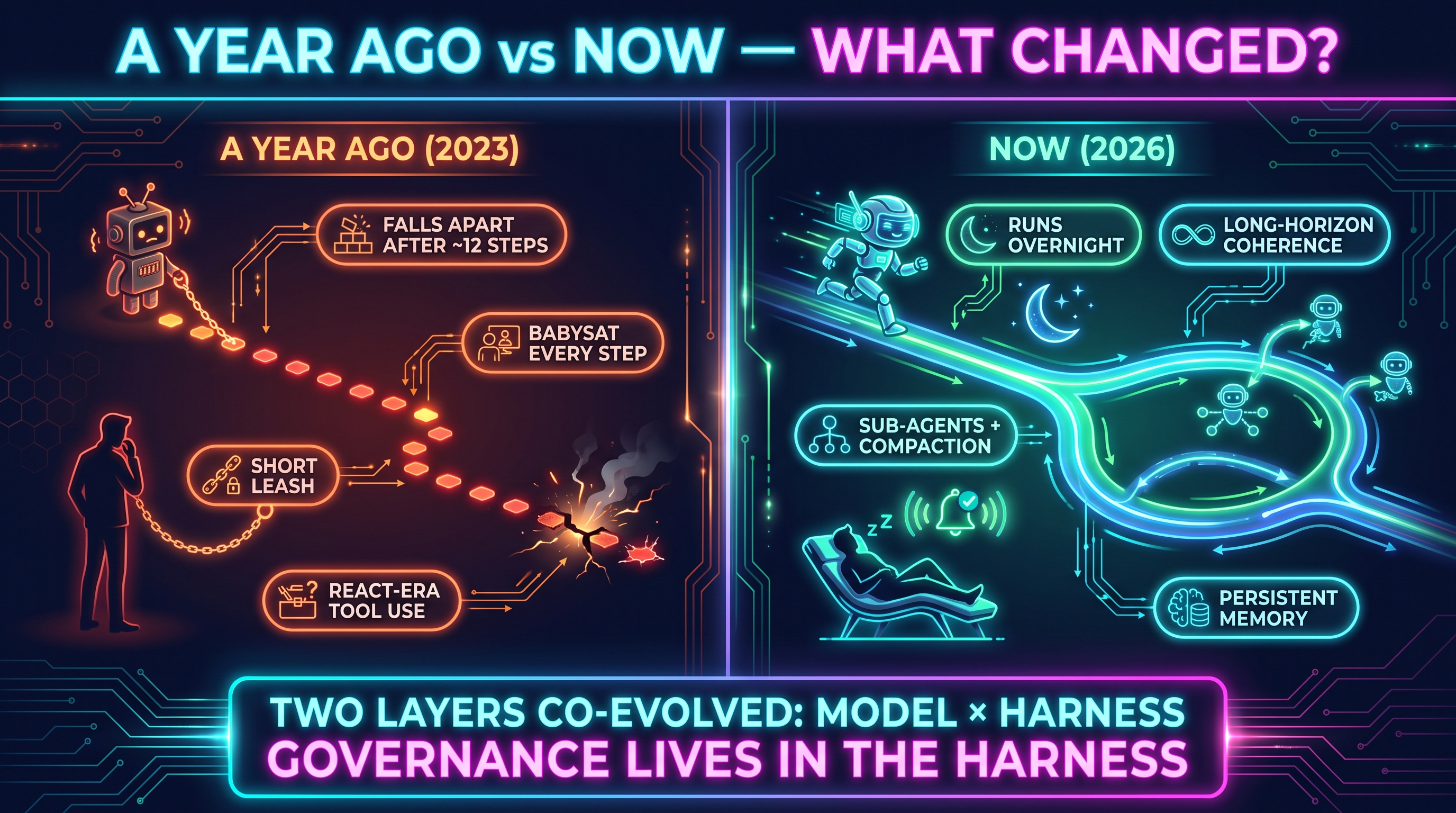
Episode 1 lead graphic — "what changed?"
Episode 1 — LinkedIn copy (Fable, reworked to teaching + your unlock)
Last month an agent ran overnight on my machine and finished work I could not have shipped a year ago. Not "faster." Could not have shipped.
My first honest question wasn't how to post about it. It was: what actually changed? The model? The tooling? Me?
The answer is that two layers crossed a threshold at the same time — and if you can't tell them apart, you can't reason about these systems. So let's take them apart.
Layer 1: the model. A year-plus ago, ReAct and Toolformer-era tool use fell apart after about a dozen steps. Errors compounded, the plan drifted, the agent lost the plot. What changed is RL training on long agentic tasks. Models now hold coherence across hundreds of steps. That's a capability shift in the weights.
Layer 2: the harness. Everything wrapped around the model: the agent loop, sub-agents, backgrounding, context compaction, persistent memory, notifications. A year ago you babysat every step. Now the orchestration layer manages the run so the model can stay on task for hours.
Here's the humbling part. Most of what felt like "I got better at this" was the substrate crossing a threshold under my feet. I learned to wield it — that's real — but I didn't cause it.
Why does the split matter beyond bragging-rights accuracy? Because governance lives in the harness. Policy enforcement, audit trails, kill switches, scoped memory — none of that is in the weights. It's implemented in the orchestration layer. If you want to make an agent safe, that's where you build.
That's what this series is about: the primitives of the harness, one at a time, until you can look at any agent system and know which layer is doing what — and which layer you can actually control.
Question to sit with: last time your agent stack failed, could you say whether the failure was in the weights or the harness?
Episode 2: Context compaction — how an agent works past its own memory limit.